Free template
Cover letter template and writing guide
Applicants who are asked for a cover letter or supporting letter with a CV.
Sduella ·
A cover letter gives the reader a reason to examine your application. Name the role, connect two important requirements to your evidence, and explain a specific reason for applying to that organisation. Repeating your entire CV uses space without answering those questions.
Use the template as a structure. Replace its prompts with your own evidence and follow the application's word or page limit. If the form asks separate questions, answer those questions directly rather than pasting a general letter into every field.
What is in the template
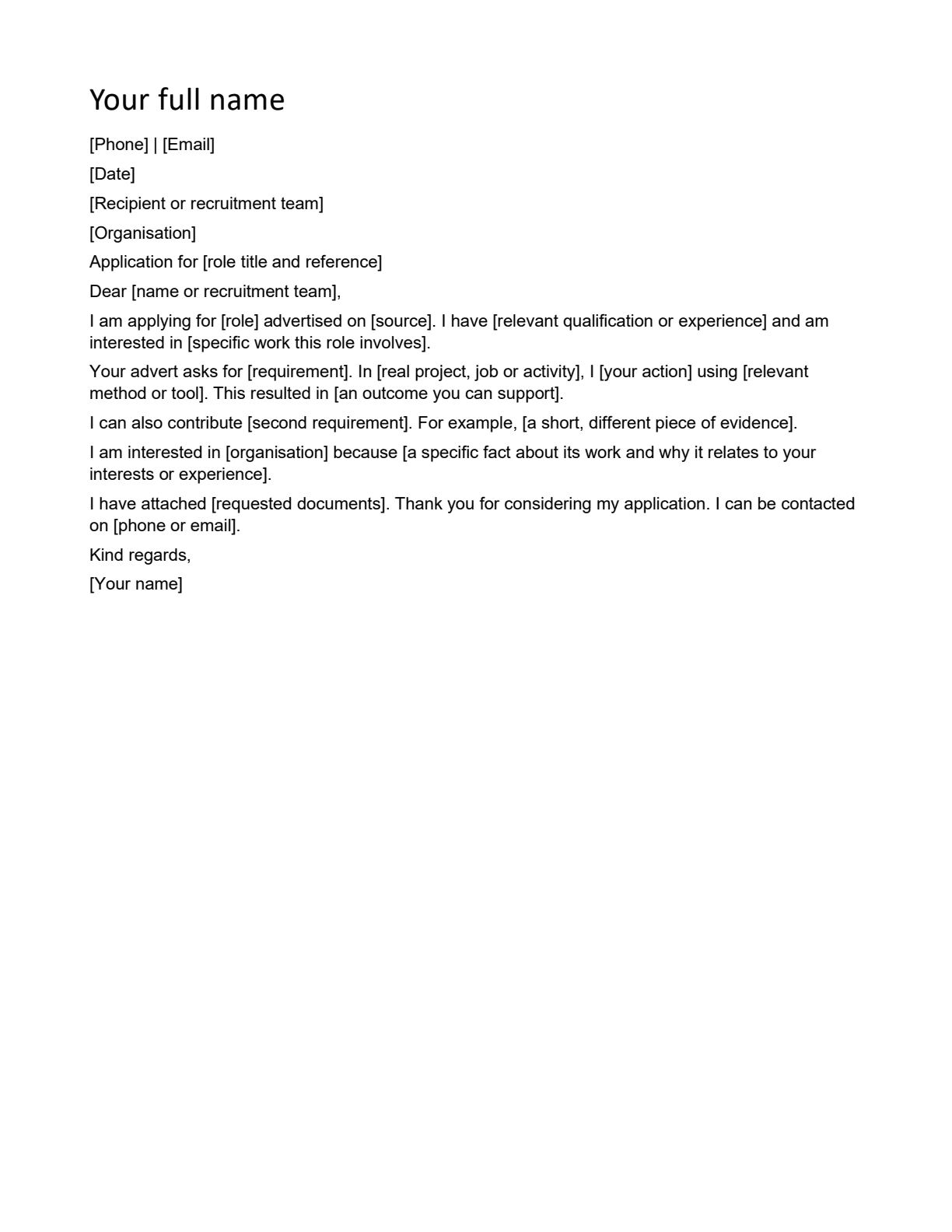
Replace the square-bracket prompts with your own information and remove sections you do not need.
Your full name
[Phone] | [Email]
[Date]

[Recipient or recruitment team]
[Organisation]

Application for [role title and reference]

Dear [name or recruitment team],

I am applying for [role] advertised on [source]. I have [relevant qualification or experience] and am interested in [specific work this role involves].

Your advert asks for [requirement]. In [real project, job or activity], I [your action] using [relevant method or tool]. This resulted in [an outcome you can support].

I can also contribute [second requirement]. For example, [a short, different piece of evidence].

I am interested in [organisation] because [a specific fact about its work and why it relates to your interests or experience].

I have attached [requested documents]. Thank you for considering my application. I can be contacted on [phone or email].

Kind regards,
[Your name]
Choose two requirements worth explaining
Read the essential requirements first. Choose the two for which you have the clearest evidence. For each, write the requirement, the activity where you used it, your action and the outcome. Those notes become the middle of the letter.
For a first-job application, choose a relevant course project or volunteer task and explain your contribution.
Write a specific reason for applying
Look at the organisation's own website and the actual job description. Identify a product, service, project or group of customers connected to the role. Explain why that work interests you and where your experience connects to it. A claim such as 'your prestigious company' could apply to almost any employer.
Check the letter against the application
- Use the correct role title and reference number.
- Explain your contribution with I when describing your own action in a team.
- Remove experience that does not help answer the requirements.
- Follow any word limit, requested file format or named recipient.
- Check that the letter and CV agree about dates, qualifications and experience.
Illustrative paragraph
Your advert asks for accurate records and clear communication. During a student society project, I recorded booking changes in a shared spreadsheet, confirmed each change with the organiser and sent attendees an updated schedule. This gave the group one current record to work from.
The paragraph connects two stated requirements to one activity. Replace the activity with your own evidence and the requirements with those in the actual advert.
Final check
- The letter names the correct organisation.
- Both evidence paragraphs answer a stated requirement.
- The reason for applying is specific to this role.
- Attachments and contact details are correct.
Further reading
Useful next resources
Editable template
CV and résumé template with no work experience
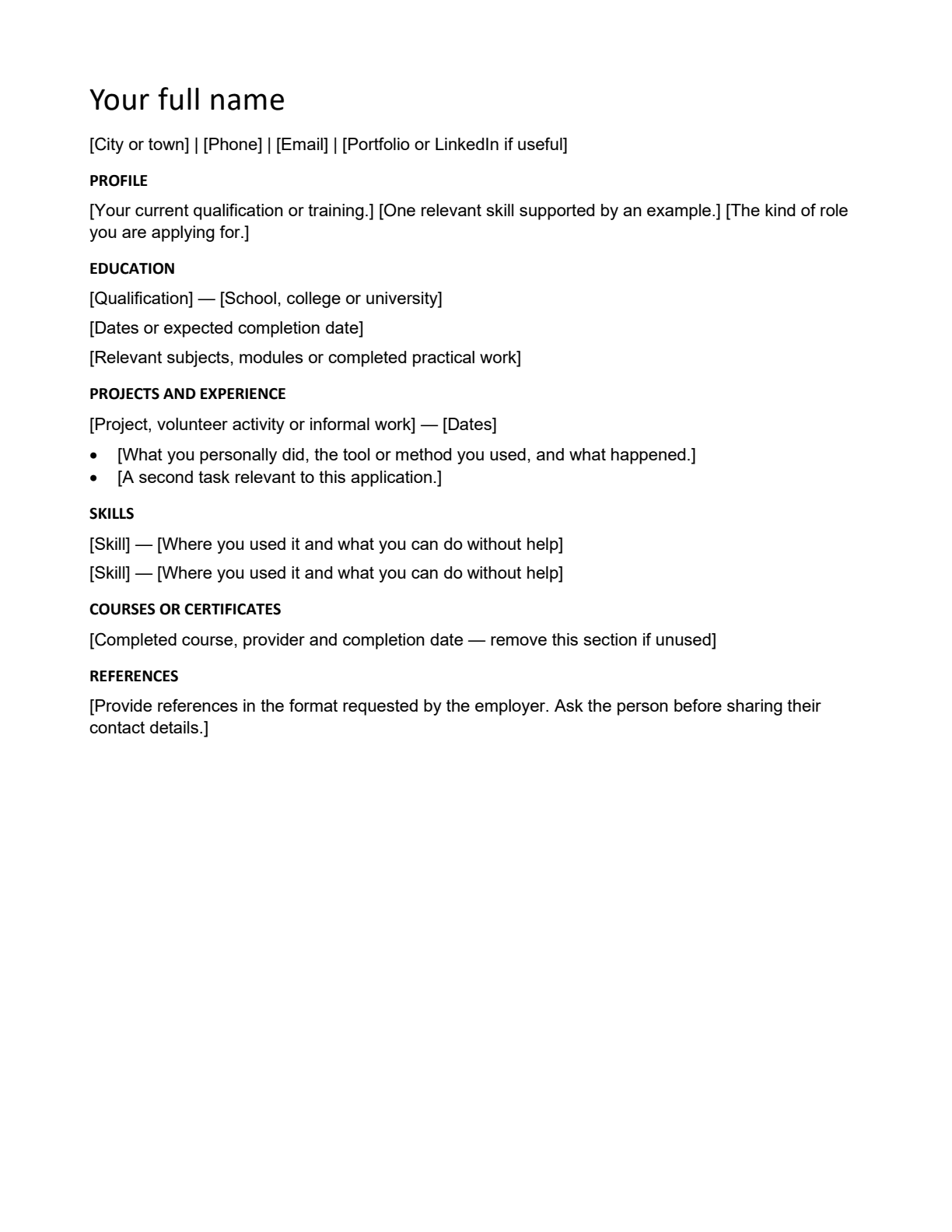
Download an editable CV or résumé for your first job. Turn school projects, volunteering and informal work into useful evidence, with a worked CV bullet example.
Use it for: First-job applicants, school leavers and students applying for internships or learnerships.
Word · PDF · Free download
Open resource and instructionsEditable template
Learnership application email template
Copy a short learnership application email, use the correct reference and check the requested attachments. Follow the provider's application instructions.
Use it for: Applicants responding to a learnership advert that specifically accepts applications by email.
Text · Free download
Open resource and instructionsEditable template
Job application tracker for Excel or Google Sheets
Download a simple CSV application tracker. Record roles, deadlines, application links, document versions, interview dates and the next action to take.
Use it for: People managing several job, internship, learnership or bursary applications.
CSV · Free download
Open resource and instructions