Free template
Bursary motivation letter template
Students applying to a bursary or scholarship that requests a motivation letter.
Sduella ·
A useful motivation letter answers the particular funder's questions: what you want to study, why you have chosen it, what evidence supports your application and, where relevant, what costs you need help with. Some funds use academic merit, some consider financial need, and others have additional requirements. Start with the published call.
The template is an outline, not a completed application. Keep financial figures consistent with the supporting documents the funder requests. If the application gives a different structure or word limit, use that structure.
What is in the template
Replace the square-bracket prompts with your own information and remove sections you do not need.
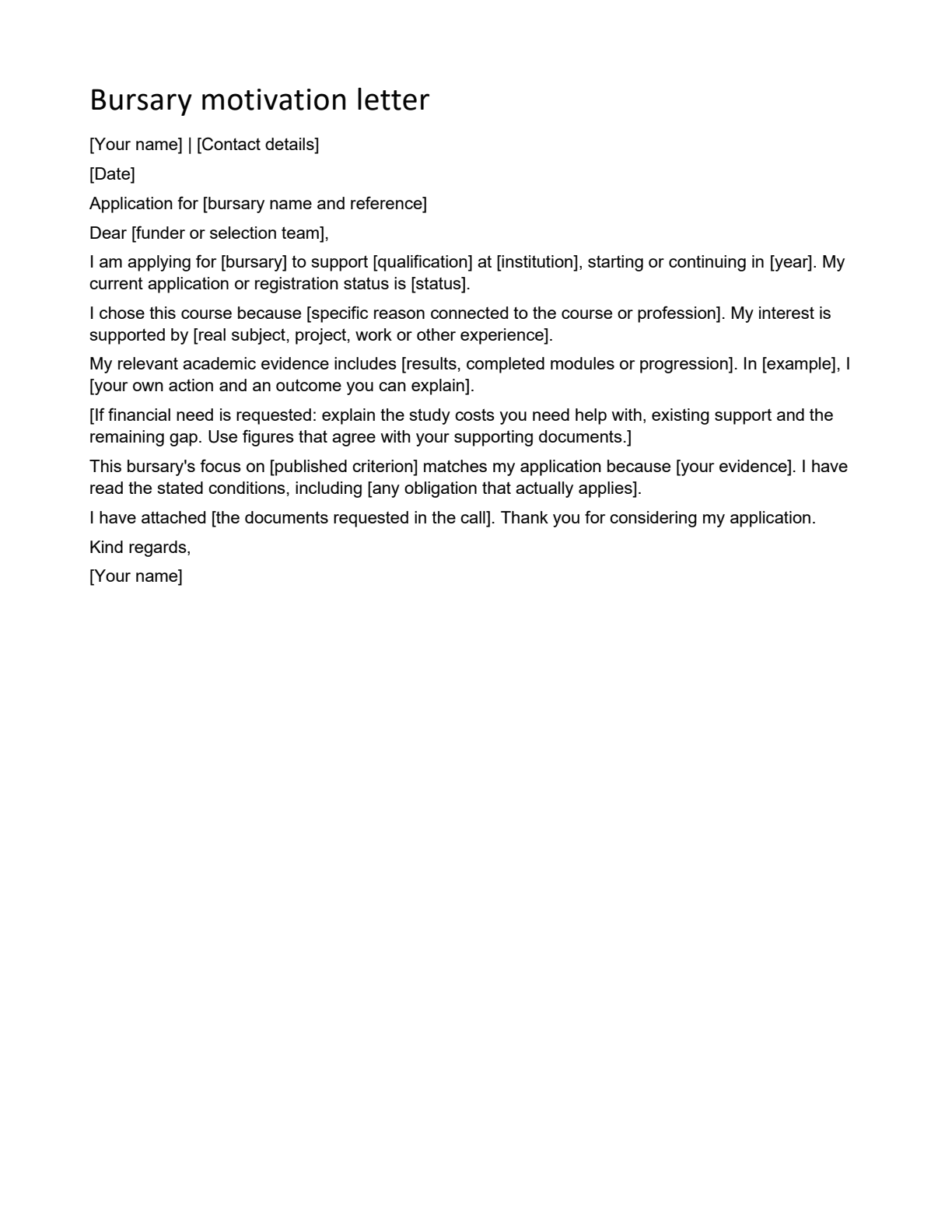
Bursary motivation letter
[Your name] | [Contact details]
[Date]

Application for [bursary name and reference]

Dear [funder or selection team],

I am applying for [bursary] to support [qualification] at [institution], starting or continuing in [year]. My current application or registration status is [status].

I chose this course because [specific reason connected to the course or profession]. My interest is supported by [real subject, project, work or other experience].

My relevant academic evidence includes [results, completed modules or progression]. In [example], I [your own action and an outcome you can explain].

[If financial need is requested: explain the study costs you need help with, existing support and the remaining gap. Use figures that agree with your supporting documents.]

This bursary's focus on [published criterion] matches my application because [your evidence]. I have read the stated conditions, including [any obligation that actually applies].

I have attached [the documents requested in the call]. Thank you for considering my application.

Kind regards,
[Your name]
Make a requirements sheet first
Put the funder's requirements in one column and the document or example supporting each requirement in another. Record the course, institution, study year, closing date and required attachments. This helps you separate eligibility facts from the reasons you want to study.
If you have applied to an institution but have not been accepted, state that accurately. If you have already registered, give the study year the funder asks for. The letter should agree with the rest of the application.
Explain the course choice with evidence
Name something concrete about the course or profession. A school subject, a practical project, a work observation or a problem you have studied can explain your interest. Describe what you learned and how it connects to the qualification. A broad promise to change the world does not tell the reader why this course fits your plans.
Describe the funding gap when asked
Separate the cost of studying from the amount already covered. For example, the requested documents may distinguish tuition, accommodation, books and transport. Use the categories in the funder's form and explain any remaining gap. Do not assume the bursary pays for every category; check its published terms.
For an interview, keep a copy of the letter and documents you submitted. Prepare to explain the same facts in your own words and to discuss any conditions attached to the award.
Illustrative opening
I am applying for [named bursary] to support the second year of my [qualification] at [institution]. My completed [module or project] helped me decide to pursue [specific area]. I am requesting support for [the study costs allowed by this fund], as explained in the attached application documents.
The opening identifies the application and study plan. It leaves eligibility and financial facts for the applicant to supply rather than inventing them.
Final check
- You have used the funder's actual criteria and word limit.
- Study status and academic results match the application.
- Any financial figures match the supporting documents.
- You understand the stated award conditions.
Further reading
Useful next resources
Interview guide
Bursary interview preparation and practice questions
Prepare for a bursary or scholarship interview using your submitted application. Practise your course choice, academic examples, study plan and funding explanation.
Use it for: Students invited to interview for a bursary or scholarship.
Open resource and instructionsEditable template
CV and résumé template with no work experience
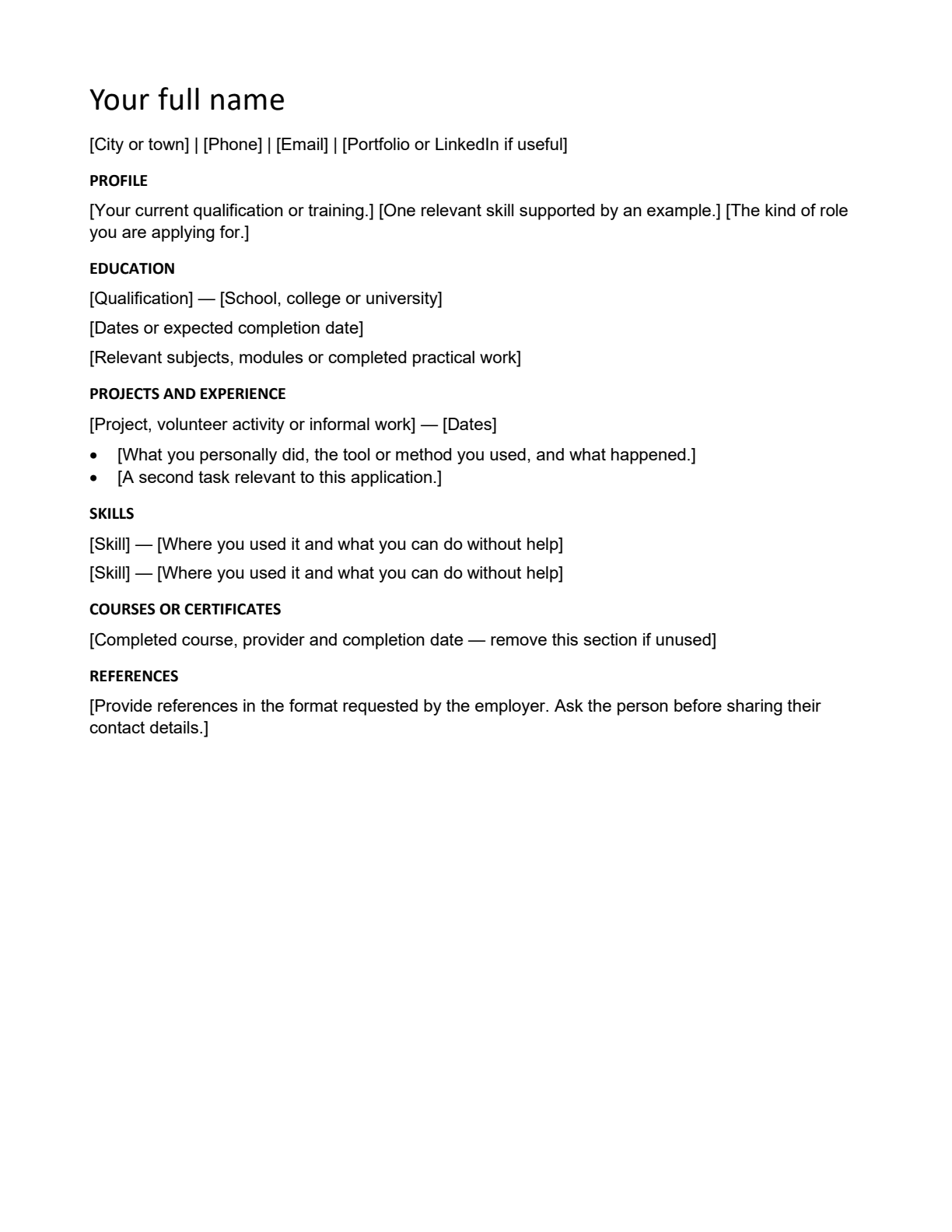
Download an editable CV or résumé for your first job. Turn school projects, volunteering and informal work into useful evidence, with a worked CV bullet example.
Use it for: First-job applicants, school leavers and students applying for internships or learnerships.
Word · PDF · Free download
Open resource and instructionsEditable template
Job application tracker for Excel or Google Sheets
Download a simple CSV application tracker. Record roles, deadlines, application links, document versions, interview dates and the next action to take.
Use it for: People managing several job, internship, learnership or bursary applications.
CSV · Free download
Open resource and instructions