Interview preparation
STAR interview method with a worked example
Applicants answering questions such as Tell me about a time you solved a problem.
Sduella ·
STAR organises an example into Situation, Task, Action and Result. It is useful for questions about something you have already done. The structure helps the interviewer follow your responsibility, your decisions and what happened.
Use it when the question asks for an example. A question about why you want a role may need a direct explanation instead. Choosing the right event matters more than reciting four headings.
Separate background from your own actions
Situation establishes the context. Task identifies what you were responsible for. Action explains the steps you took and why. Result describes the outcome and anything you learned. Your answer should make it possible to distinguish your work from what the rest of the team did.
A result does not need an invented percentage. A corrected record, a completed task or a changed process can be an observable result. Explain how you know it happened. If the attempt did not succeed, say what happened and what you changed afterward.
Work through this example
The example below concerns a student group preparing an event. Its useful detail is the check against the original booking emails. That shows a method, rather than relying on a general claim about being organised.
The applicant also states a limit: they were responsible for the attendance list, not the whole event. That gives the interviewer a clear starting point for a follow-up about accuracy, communication or responsibility.
Use a question to choose the next example
- Teamwork: when did people depend on your contribution?
- A mistake: what went wrong, and what did you do after noticing it?
- Priorities: how did you choose between two competing tasks?
- Learning: what did you have to understand before completing a task?
- Communication: when did you check another person's understanding?
Do a short practice round
Write one example as notes in the worksheet. Say it aloud once. Ask a listener to identify your responsibility, one action and the result. If they cannot identify one of those parts, add the missing detail rather than making the answer longer everywhere.
Fictional worked example: checking an event list
Situation: Our student group was preparing an event and the attendance list contained duplicate bookings. Task: I was responsible for giving the organiser an accurate list. Action: I compared the spreadsheet entries with the original booking emails, marked duplicates and asked the organiser to confirm two unclear entries. I then sent a dated final version. Result: The organiser used the corrected list for check-in. I also kept a short note of the checks so the group could repeat them for the next event.
The actions explain a check, an escalation and a handover. The result is observable without an invented statistic. This is a practice example, not an experience to claim as your own.
Final check
- You chose an event relevant to the question.
- Your own responsibility is explicit.
- The action includes a method or decision.
- The outcome and limits are accurate.
Further reading
Useful next resources
Editable template
STAR interview answer worksheet
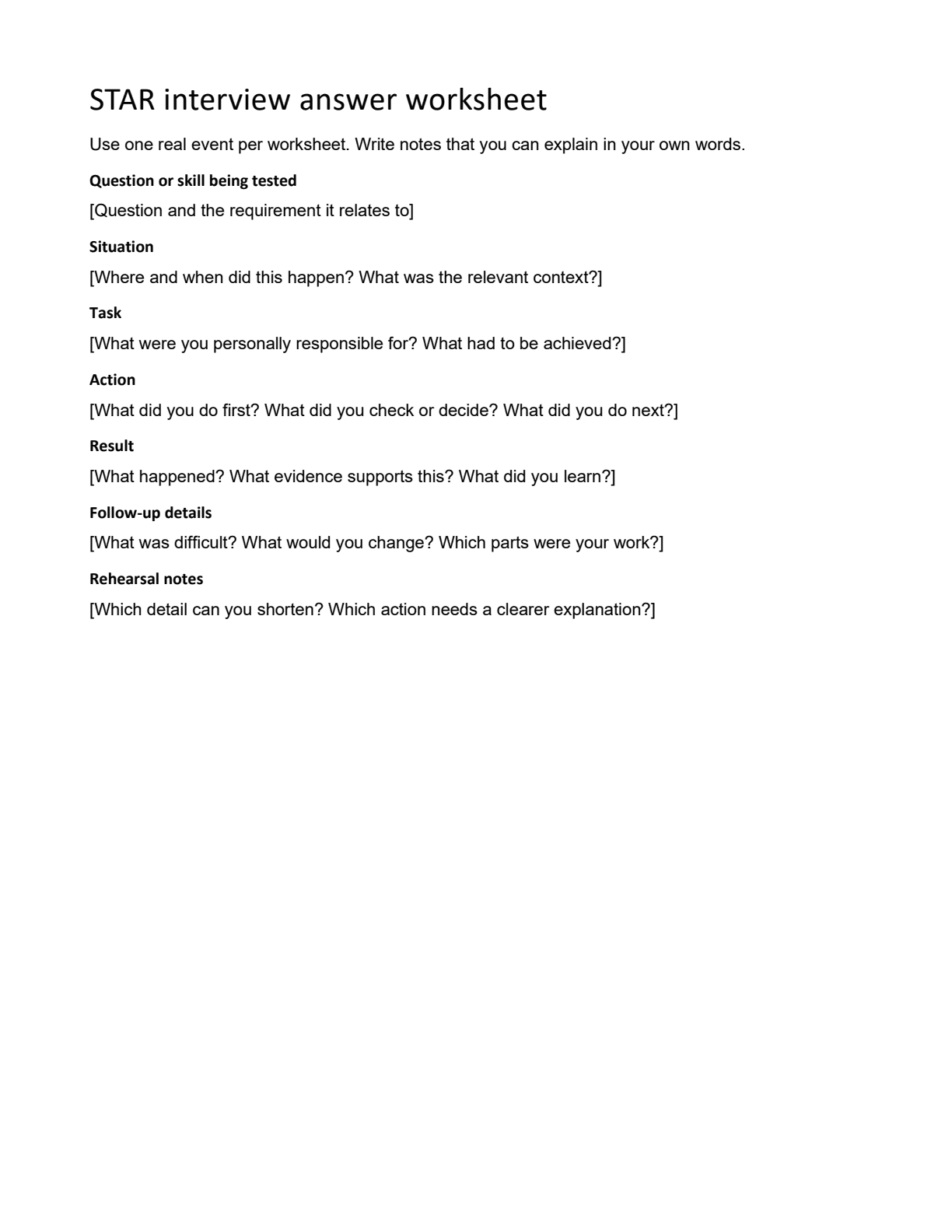
Build interview examples from your own experience with a STAR worksheet. Record the situation, your responsibility, your actions, the outcome and follow-up detail.
Use it for: Applicants preparing examples for behavioural or competency interview questions.
Word · PDF · Free download
Open resource and instructionsInterview guide
How to answer Tell me about yourself
Prepare a short interview introduction with real evidence. See a first-job example, understand what to change and practise the follow-up questions.
Use it for: First-job, internship and early-career applicants preparing their opening answer.
Open resource and instructionsInterview guide
Accounting internship interview preparation
Prepare evidence for an accounting internship interview. Practise discussing accuracy, spreadsheets, reconciliation, an error and the limits of your experience.
Use it for: Students and graduates applying for entry-level accounting or finance administration internships.
Open resource and instructions